Featured Courses
Tri-Faith Initiative offers opportunities to explore interfaith topics in greater depth through a selection of engaging courses.
Each Tri-Faith course incorporates academic research, diverse perspectives, facilitates fruitful dialogue, and supports meaningful learning that advances interfaith relationships and understanding.
Religious Equity Seminar 2026
Click here to register and save your seat today!
Tri-Faith’s Religious Equity Seminar equips community members and leaders to build thriving, inclusive communities that celebrate religious pluralism as a social norm. As Omaha grapples with demographic changes and the legacy of racism and religious bigotry, healing divisions and building cross-cultural relationships have never been more urgently needed. Nearly 80% of hate crimes with religious bias target Jews and Muslims. The Religious Equity Seminar will provide an understanding of religious equity, diversity, and inclusion issues surrounding religion in America through historical, cultural, and structural analysis. This seminar advocates for Equitable Pluralism, the concept that all people should not only have the right to be themselves, but also should be able to truly flourish while being different from each other.
The Religious Equity Seminar is intended for community members and leaders who want to build genuinely inclusive spaces, whether in workplaces, congregations, schools, or civic organizations. This includes nonprofit staff, educators, faith leaders, HR professionals, and engaged community members who regularly interact with religiously diverse populations but may lack a shared historical framework for understanding how religious bias forms and persists. The seminar will train participants with skills for applying learned knowledge to everyday and professional life.
Participants will be educated on and engage in discussion regarding equity issues for the religious experiences of Jews, Muslims, Native Americans, and African Americans (with the future goal of additional interchangeable modules of religious and intersectional experiences). Drawing upon sociological case studies, historical studies, and current events, each of these sections will follow a similar pedagogical format interweaving presentations, activities, and discussions.
- Session 1: Monday, October 12, 2026: “Introduction” and “Religious Freedom & Foundations: Part 1”
- Session 2: Wednesday, October 14, 2026: “Religious Freedom & Foundations: Part 2”
- Session 3: Monday, October 26, 2026: “Religious Equity: Jewish Considerations”
- Session 4: Wednesday, October 28, 2026: “Religious Equity: Muslim Considerations”
- Session 5: Monday, November 9, 2026: “Intro to Race & Religion,” and “Religious Equity: Native American Considerations.”
- Session 6: Wednesday, November 11, 2026: “Religious Equity: African American Considerations”
- Session 7: Monday, November 23, 2026: “Christian Nationalism”
- Session 8: Monday, December 7, 2026: “Equitable Pluralism: Part 1”
- Session 9: Wednesday, December 9, 2026: “Equitable Pluralism: Part 2” and “Conclusion”
This seminar gives participants concrete historical grounding and practical tools, like the Five B Framework and the Bridge-Building Model, to translate goodwill into informed, actionable behavior in their own spheres of influence. Participants will walk away with practical tools for driving real change where they work and live, not just a better vocabulary for naming the problem.
Tri-Faith’s collaborative model extends beyond our own campus. This course was built the same way we build everything; by bringing people from different faiths, disciplines, and lived experiences to the same table.
We consulted scholars and community leaders from the University of Nebraska Omaha, the University of Nebraska Lincoln, the Schwalb Center for Israel and Jewish Studies, the Harris Center for Judaic Studies, the Goldstein Center for Human Rights, the Institute for Holocaust Education, ADL Midwest Region, the Movement in Omaha for Racial Equity, and Bluebird Cultural Initiative, along with independent scholars, attorneys, and educators. Each module, Native American Considerations, Muslim Considerations, Jewish Considerations, and African American Considerations, was shaped directly by experts and community members with lived or professional connection to that history, rather than written about them from the outside.
Participants will leave with a clearer lens for spotting religious inequity in their own organizations and in society more broadly, and the historical grounding to see how today’s headlines connect to centuries-old competing narratives about religion in the United States. That understanding is meant to translate into action. Participants will walk away with practical tools for driving real change where they work and live, not just a better vocabulary for naming the problem.
The course also asks participants to hold two truths at once, that religious bigotry and racism often reinforce each other, and that neither can be fully addressed in isolation. From there, we push further, asking what an equitably pluralistic United States could actually look like, and being honest about the limits of secularism as well as the ongoing pull of Christian Nationalism.
The broader community outcome is a growing group of Nebraskans equipped to build genuine understanding across religious difference, and to do it together rather than apart.
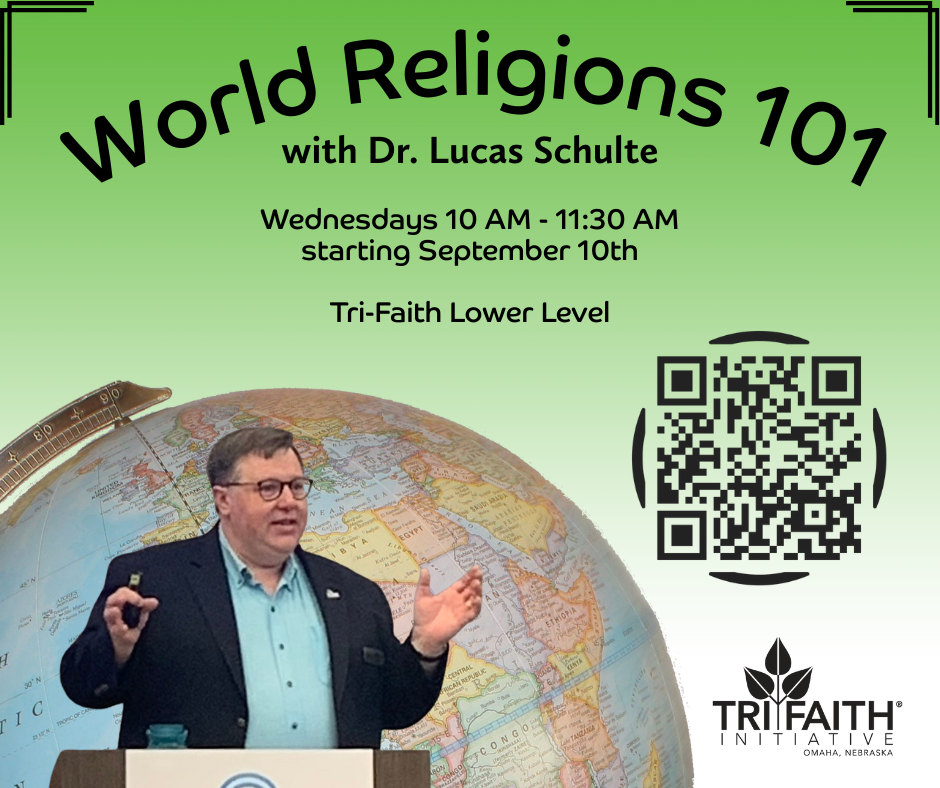
A Tri-Faith Introduction to World Religions (2025)
Have you ever been curious about other religions?
As part of Tri-Faith’s mission to “cultivate inclusive environments to advance interfaith relationships and understanding,” this course seeks to advance interfaith understanding by teaching about some of the faiths and religions of the world. The course begins with an introductory session about the religious studies approaches used for the course, as well as discussing different definitions for “religion.”
The course will then spend two sessions each on the following religions: Hinduism, Buddhism, Zoroastrianism, Judaism, Christianity, and Islam (future versions of this course will interchange some of these for other religions such as Jainism, Shintoism, Taoism, Confucianism, Sikhism, etc.). Topics will include information about the population size and geographical concentrations of these various religions, an introduction to some of the core tenets of each religion, an overview of some of the major sacred writings and scriptures within the religion, a brief introduction to key and/or foundational figures within each religion, a timeline and historical overview of major events and people within the history of each religion, and an overview of some of the major branches within the religion.
- Introduction: Overview of the global and US religious landscapes, a discussion of the definitions of “religion” and their limitations, and an introduction to a religious studies approach (in contrast to theological or faith-based approaches).
- Hinduism 1: An intro to Hinduism, the Indus Valley Civilization and connections to other cultures, Vedic culture
- Hinduism 2: the Upanishads, social classes, the Bhagavad Gita, classical theism and branches.
- Oct. 8 – Buddhism 1: An intro to Buddhism, Three Jewels, Siddartha Gautama (the Buddha), Essentials of the Buddha’s Teaching
- Buddhism 2: The spread of Buddhism, Theravada, Mahayana and new ideas, Bodhisattvas, Pure Land Buddhism, Zen Buddhism, Vajrayana Buddhism, views from Tibet.
- Zoroastrianism 1: An intro to Zoroastrianism, origins, Zarathustra, Zoroastrian Teachings, Zoroastrian practices
- Zoroastrianism 2: The ancient Persian Empire, ancient Zoroastrianism and other religions, Persian Paradise, Later influences.
- Judaism 1: An intro to Judaism, the Tanak, Religion in ancient Judah and Israel, Second Temple Judaism
- Judaism 2: Early Rabbinic Period, Judaism under Christian and Islamic Rule, Emancipation and Change, the Shoah and aftermath, Modern Judaism, Teachings of Judaism, Major Branches of Contemporary Judaism.
- Christianity 1: An intro to Christianity; differences between Protestant, Catholic, and Eastern Orthodox bibles; the life and teachings of Jesus of Nazareth; early spread of Christianity;
Constantine and Christianity. - Christianity 2: Early Divisions in Christianity; The Great Schism between Eastern and Western Christianity; Medieval Christianity; the Protestant Reformation and Catholic Counter-Reformation; Christianity’s family tree of denominations.
- Islam 1: An intro to Islam; Arabia before Islam; the Qur’an; the Prophet Muhammad; The Spread of Islam
- Islam 2: the Five Pillars of Islam; Branches of Islam (Sunni and Shi’a); Sufism; Mosques; Islam in the World.
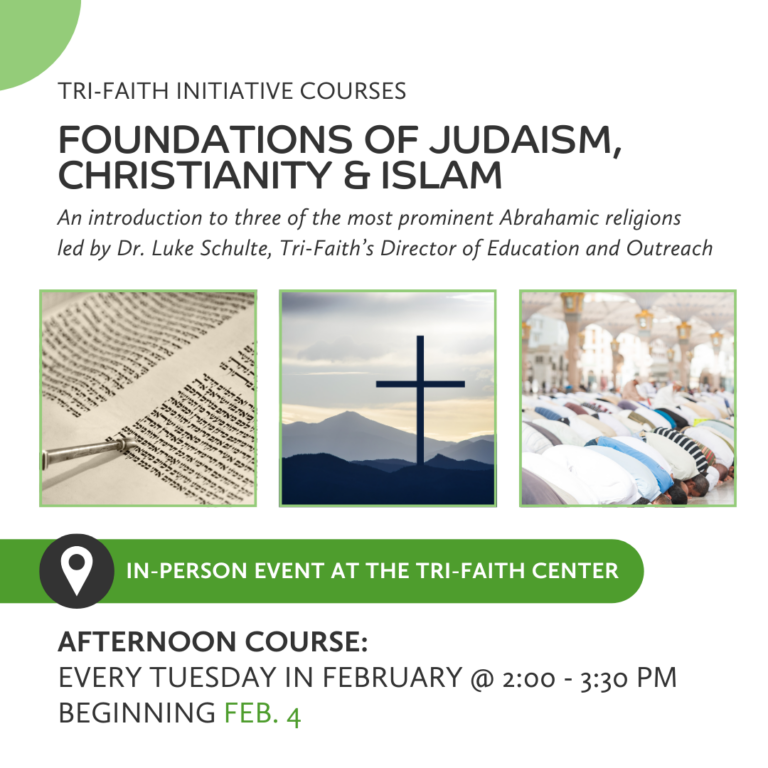
The Foundations of Judaism, Christianity, and Islam
Afternoon In-Person Offering: Tuesdays from 2:00 to 3:30 PM, beginning February 4th through February 25th , hosted in the Tri-Faith Center.
Cost: This five-session course is provided to the community at no cost, though donations that help Tri-Faith staff continue to develop high-quality programs are strongly encouraged.
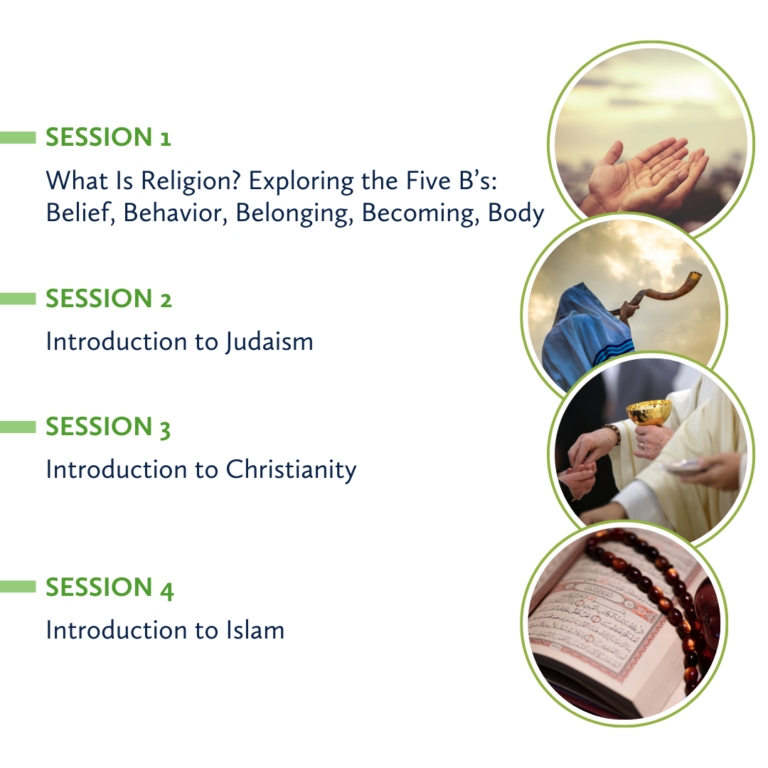
Course Overview: This course is an introduction to the three of the most prominent religious traditions in human history: Judaism, Christianity, and Islam. It will consist of a brief historical overview of each these three traditions as well as a discussion of the Five Bs of religion as they relate to each tradition: Belief, Behavior, Belonging, Becoming, and Body.
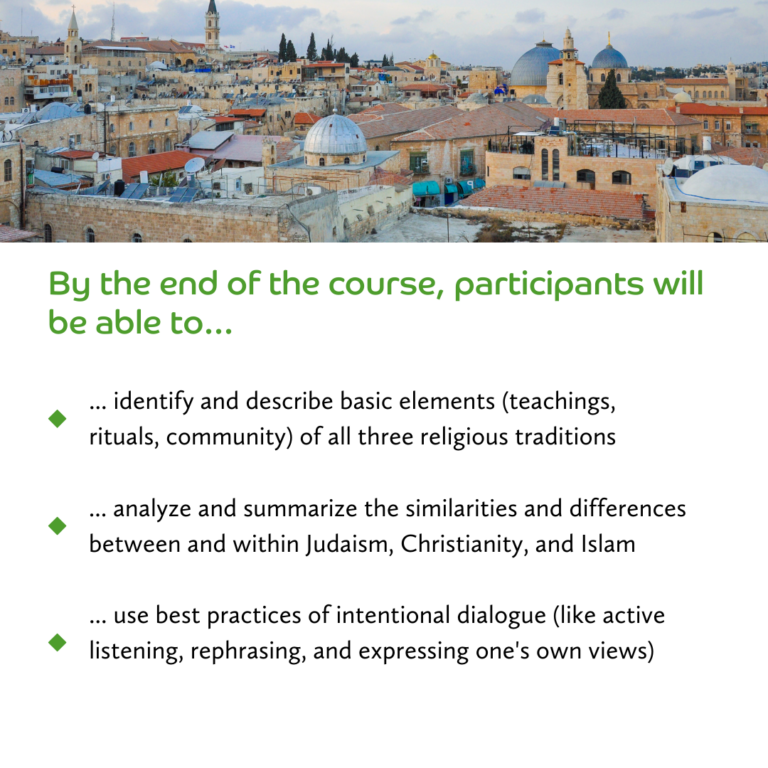
By the end of the course, participants will be able to identify and describe basic elements of all three religion traditions, analyze and summarize the similarities and differences between and within Judaism, Christianity and Islam, and use best practices of intentional dialogue like active listening, rephrasing, and expressing one’s own views.
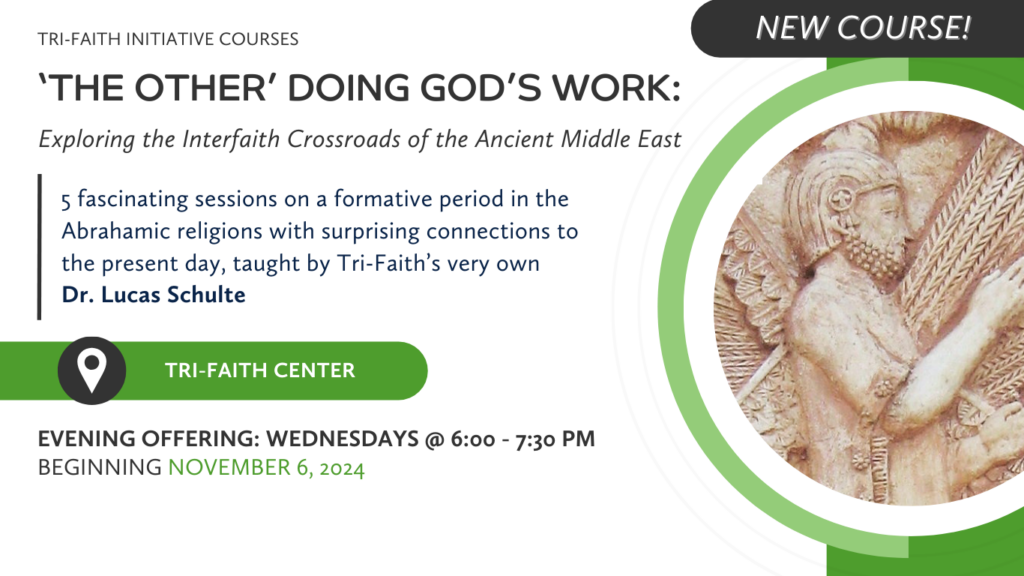
‘The Other’ Doing God’s Work: Exploring the Interfaith Crossroads of the Ancient Middle East
Afternoon In-Person Offering: Tuesdays from 2:00 to 3:30 PM, beginning Aug. 27 through Sept. 24, hosted in the Tri-Faith Center.
Evening In-Person Offering: Wednesdays from 6:00 to 7:30 PM beginning Nov. 6 through Dec. 11 (Skipping the week of Nov. 27 due to Thanksgiving), hosted in the Tri-Faith Center.
Cost: This five-session course is provided to the community at no cost, though donations that help Tri-Faith staff continue to develop high-quality programs are strongly encouraged.
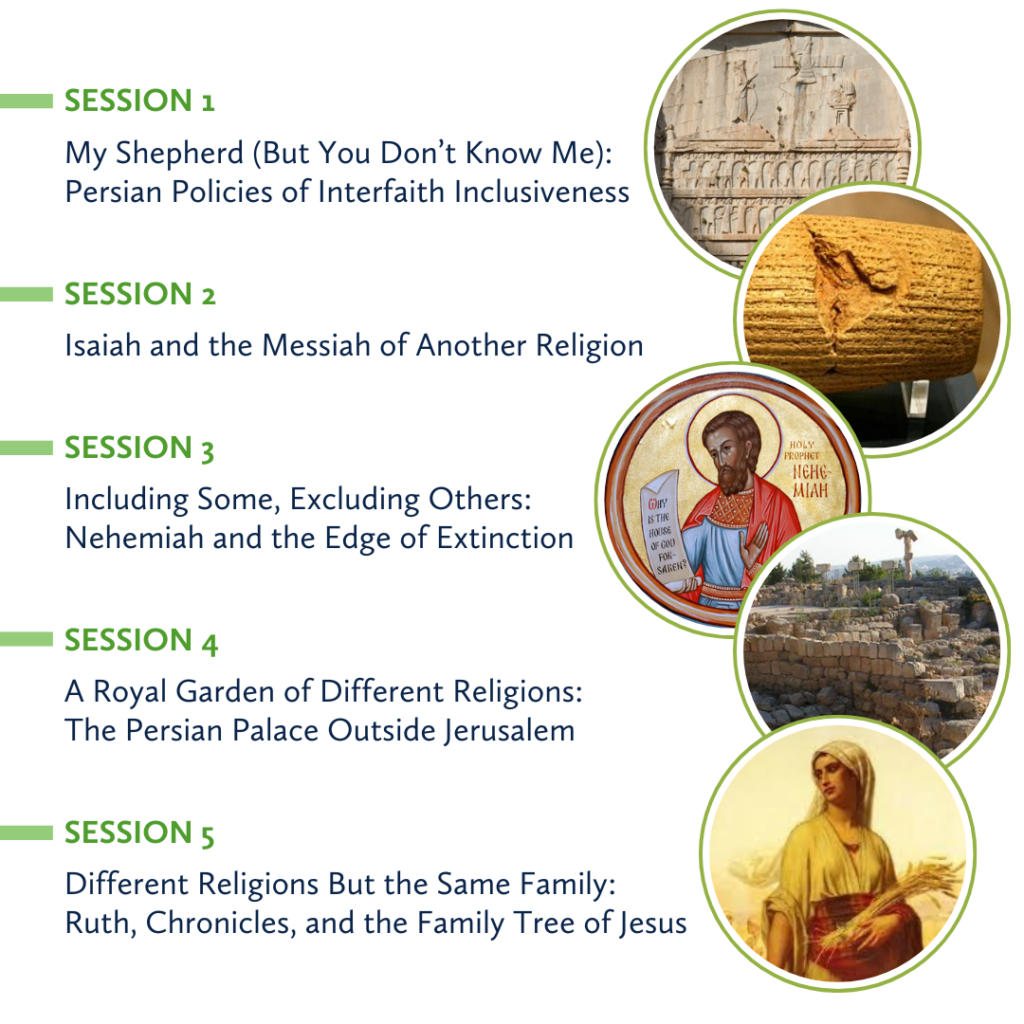
Course Overview: Seeing the beautiful and dutiful ways in which our neighbors practice their faith and live out their values can inspire us to be more engaged in our own faith; indeed, this is the kind of inspiration that can be (and so often is) drawn from the Tri-Faith Commons.
But how were the Abrahamic religions as we know them today shaped by this kind of inspiration, this “holy envy,” as Krister Stendahl called it? To find out, we must journey back to a time when prophets and scribes believed a Zoroastrian Persian emperor served as a prime example of expressing Jewish values.
Leveraging fascinating content about the Persian period that Dr. Lucas Schulte has curated, as well as some new knowledge that he has contributed to the field throughout his career, this five-session course aims to move audiences beyond limiting misconceptions (ex: “The Middle East has always been embroiled in bloody religious conflict”) and offer them a fresh perspective on a critical, transformative period for Judaism — and later, a pivotal point of reflection for Christianity and Islam.
When we discover that the interfaith relations of the past were far more interesting and experimental than we thought, we tend to approach the perceived limitations of the present with renewed hope!
Though we recommend attending all five sessions consecutively, each session is a stand-alone learning experience.
‘The Other’ Doing God’s Work: Exploring the Interfaith Crossroads of the Ancient Middle East
Afternoon In-Person Offering: Tuesdays from 2:00 to 3:30 PM, beginning Aug. 27 through Sept. 24, hosted in the Tri-Faith Center.
Evening In-Person Offering: Wednesdays from 6:00 to 7:30 PM beginning Nov. 6 through Dec. 11 (Skipping the week of Nov. 27 due to Thanksgiving), hosted in the Tri-Faith Center.
Cost: This five-session course is provided to the community at no cost, though donations that help Tri-Faith staff continue to develop high-quality programs are strongly encouraged.
Course Overview: Seeing the beautiful and dutiful ways in which our neighbors practice their faith and live out their values can inspire us to be more engaged in our own faith; indeed, this is the kind of inspiration that can be (and so often is) drawn from the Tri-Faith Commons.
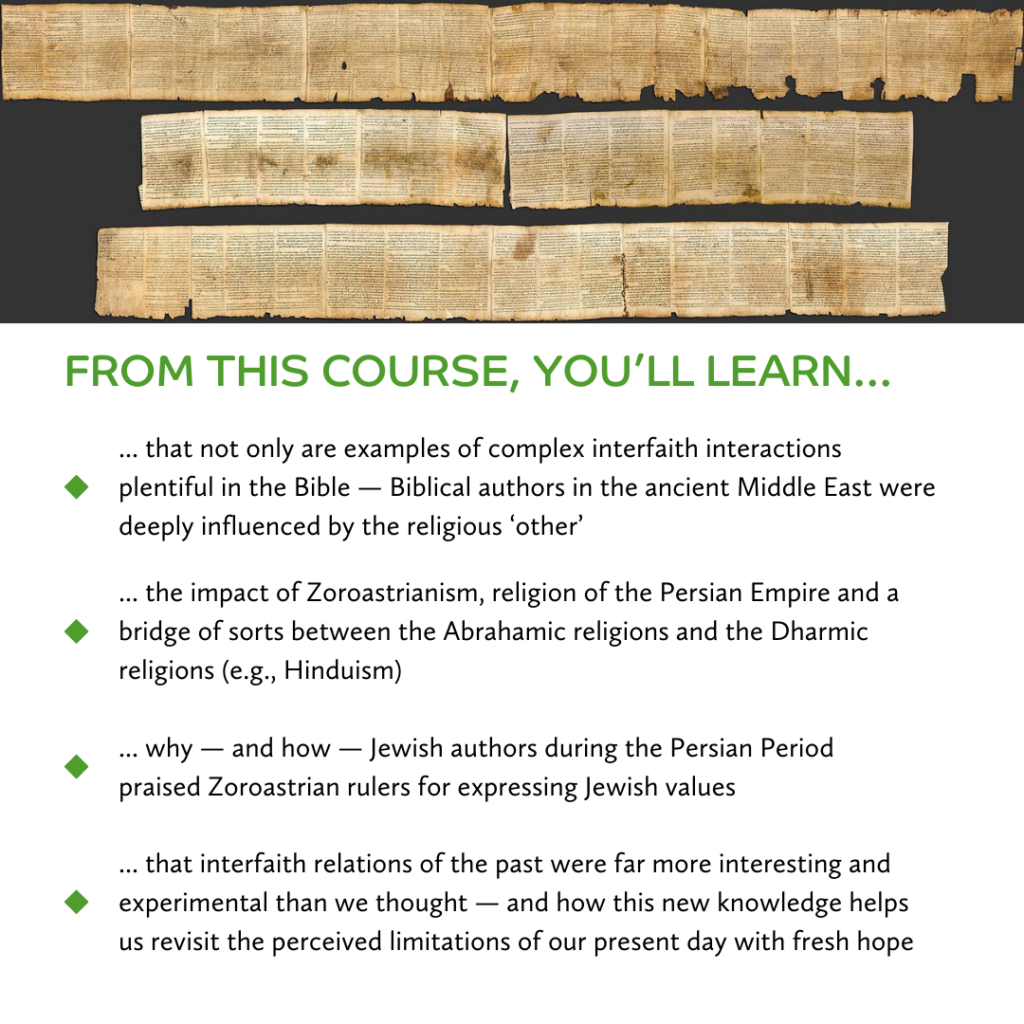
But how were the Abrahamic religions as we know them today shaped by this kind of inspiration, this “holy envy,” as Krister Stendahl called it? To find out, we must journey back to a time when prophets and scribes believed a Zoroastrian Persian emperor served as a prime example of expressing Jewish values.
Leveraging fascinating content about the Persian period that Dr. Lucas Schulte has curated, as well as some new knowledge that he has contributed to the field throughout his career, this five-session course aims to move audiences beyond limiting misconceptions (ex: “The Middle East has always been embroiled in bloody religious conflict”) and offer them a fresh perspective on a critical, transformative period for Judaism — and later, a pivotal point of reflection for Christianity and Islam.
When we discover that the interfaith relations of the past were far more interesting and experimental than we thought, we tend to approach the perceived limitations of the present with renewed hope!
Though we recommend attending all five sessions consecutively, each session is a stand-alone learning experience.
Spread the Word
